
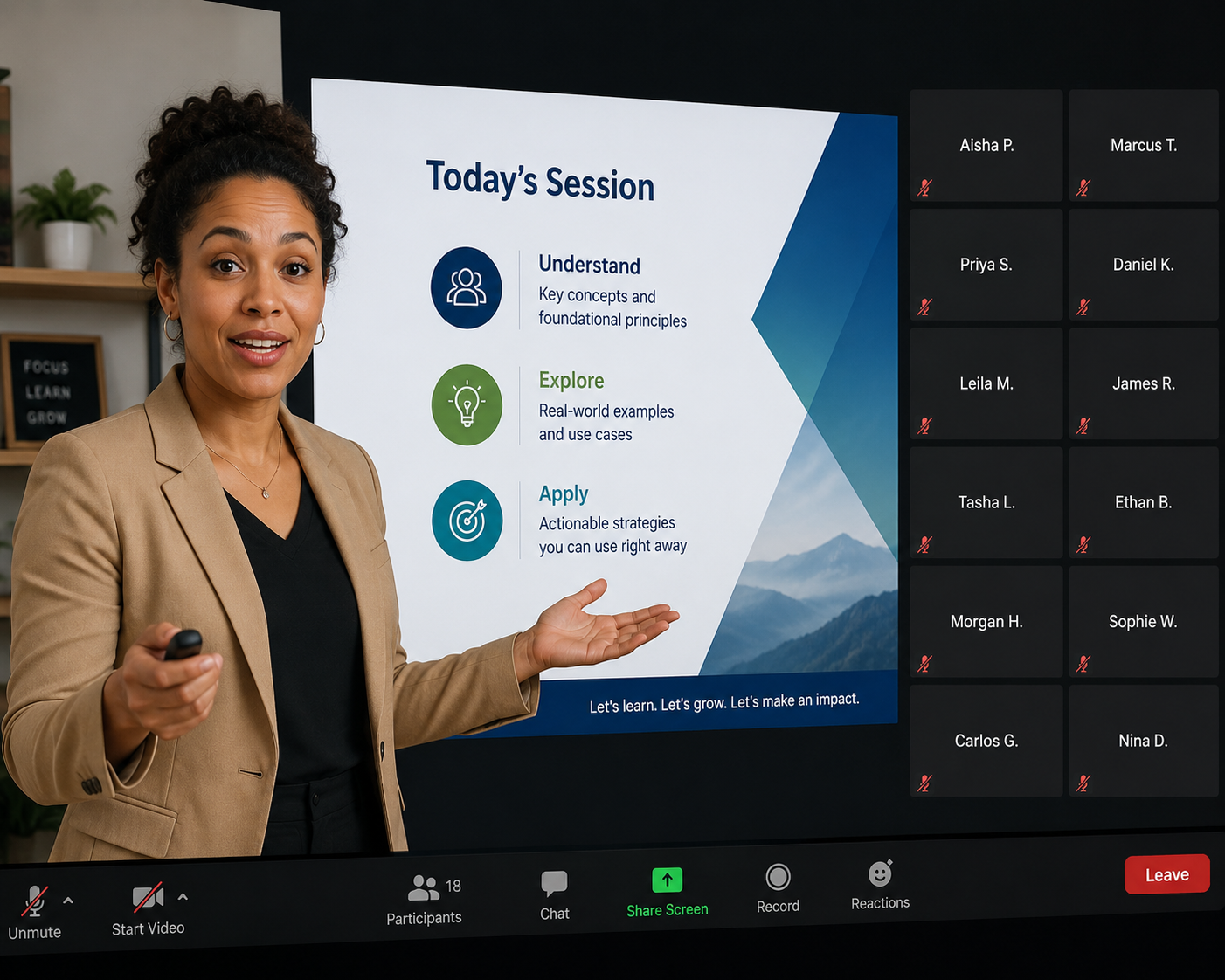
I was running a virtual leadership training for one of my clients a few weeks ago, and the first thing I noticed was that not a single person had their camera on. Just a screen full of black boxes with names floating in the middle of them. I’ll be honest, I find that odd. If we were in the same room, we’d be able to see each other. So why hide?
I kept my camera on and started the session. Any training I run is completely interactive, which means I need people to participate. Not for my benefit. I believe people learn from each other, and participation breeds participation, which builds teams, and so on down the line. In this session, I got radio silence.
So I changed my tone and my approach, and eventually I cracked the seal. What I was watching was fear.
Fear of what, you might ask. Fear of being wrong. Fear of saying the wrong thing in front of the boss. Fear of being on the record with an opinion that might not pan out. The room went quiet, and once I understood why, the rest of the training made sense.
This was a team that had gotten very good at doing exactly what the CEO wanted. They could take a directive and execute it flawlessly. What none of them had ever learned to do, or been given the space to do, was form a point of view and put it on the table. They could follow a directive all day long. Making their own call was a different muscle, and it had gone unused for a long time.
That’s a real problem, and it’s a bigger one than it looks. A company that runs on compliance can only move as fast as the one person handing out the directives.
Fear doesn’t stay where it starts
Here’s the part I’ve watched play out in company after company, and I’ve lived inside it myself earlier in my career. This kind of fear almost always starts at the top. A CEO reacts badly to being challenged one too many times, or just has a way of making disagreement feel costly, and the senior team quietly learns to stop pushing back. Then that same caution rolls downhill. The next layer starts managing the mood of the people above them instead of doing their actual jobs. Their teams pick up on it and do the same. Before long the whole company is spending its energy reading the room instead of moving the work along.
It reminds me of the old experiment with fleas in a jar. Put the lid on and the fleas jump up, hit it, and fall back. Over and over. Eventually they stop jumping high enough to escape. Then you take the lid off, and they still don’t jump out. They’ve learned the ceiling, and the ceiling isn’t even there anymore. That’s what fear does to a team. The thing that taught them to stay down is long gone, and they’re still staying down.
You can see it in the meetings
The clearest place to catch this is in the meetings. They stop being a place to talk through ideas and turn into a recitation of tasks. Everyone reports what they finished and what they’re doing next, heads nod, and nobody says the thing they’re actually worried about. No half-formed ideas. No one disagreeing out loud. The meeting ends on time and nothing real ever got discussed. If your status meetings feel efficient and your company still feels stuck, this is usually why.
How you change it
The hard truth is that this one starts with the person at the top, usually the founder or CEO. You can run all the training you want, but if the leader responds to a dissenting opinion with a sigh, a sharp tone, or by shutting it down, everyone in the building gets the message and goes quiet again. So the first piece of work is often with the CEO, helping them see how their own reactions have been teaching people to stay silent.
From there, the pattern shifts based on a handful of habits, and they’re less complicated than they sound.
Most of it comes down to how you respond the first few times someone tells you something you don’t want to hear. When a person raises a concern or makes a judgment call that doesn’t pan out, a calm, curious response instead of punishment sends a clear message. Word travels fast. People decide whether it’s safe to speak up based on what happens to the first one who tries.
You also have to give people real decisions to own, including ones they might get wrong. The confidence to make a call comes from making calls, getting a few wrong, and seeing that the company didn’t fall apart. When every decision routes back up to the CEO, nobody below ever builds that muscle.
And the meetings have to change. Stop letting them devolve into status updates. Ask people for their opinions directly, by name, and sit through the silence until someone answers. Ask what they would do differently. When someone disagrees with you, thank them out loud so the rest of the room sees it land just fine.
That’s close to what I did in that training. I stopped addressing the room as a whole and started asking individuals simple, low-stakes questions with no wrong answers. When the first person gave me a real opinion instead of a safe one, I made a point of telling her it was a good thought. A couple of cameras came on. By the end, we were talking.
A company can’t grow on quiet
A business can only grow as fast as its people are willing to make decisions. When everyone is waiting for permission, the whole thing slows to the speed of one person, usually the founder, and that founder quietly becomes the ceiling on what the company can become. The cameras being off was just the surface of it. Underneath was a team full of capable people who had learned that the safest move was to stay quiet. Growth needs people who will speak up and move things forward without first checking whether they’re allowed to.